






This store requires javascript to be enabled for some features to work correctly.
Genuine pashmina is not an ordinary textile. It is the result of time, experience, and centuries of craftsmanship. Every fiber, every weaving movement, and every natural nuance tells of a process that consciously avoids industrial mass production. Pashmina is not created through speed—but through patience.
Cashmere and pashmina both stand for exceptional softness, warmth, and quality. In everyday language, the terms are often used interchangeably – but they differ in subtle yet essential ways in their origin, fineness, and processing. Pashmina is often mistakenly understood as a blend of materials, but it refers to the purest and finest form of cashmere . Genuine pashmina consists of 100% exceptionally fine cashmere fiber , obtained exclusively from the undercoat of the Changthangi goat and traditionally processed by hand – rarer, lighter, and more demanding than conventional cashmere. Knowing these differences means choosing the material more consciously.

Cashmere generally refers to the fine undercoat of goats raised in various regions of the world – primarily in Mongolia and China. Due to rising global demand, cashmere is often harvested on a large scale, frequently involving intensive and unsustainable production methods. The fibers are then processed into a wide range of qualities – from industrially manufactured textiles to high-quality natural fabrics.
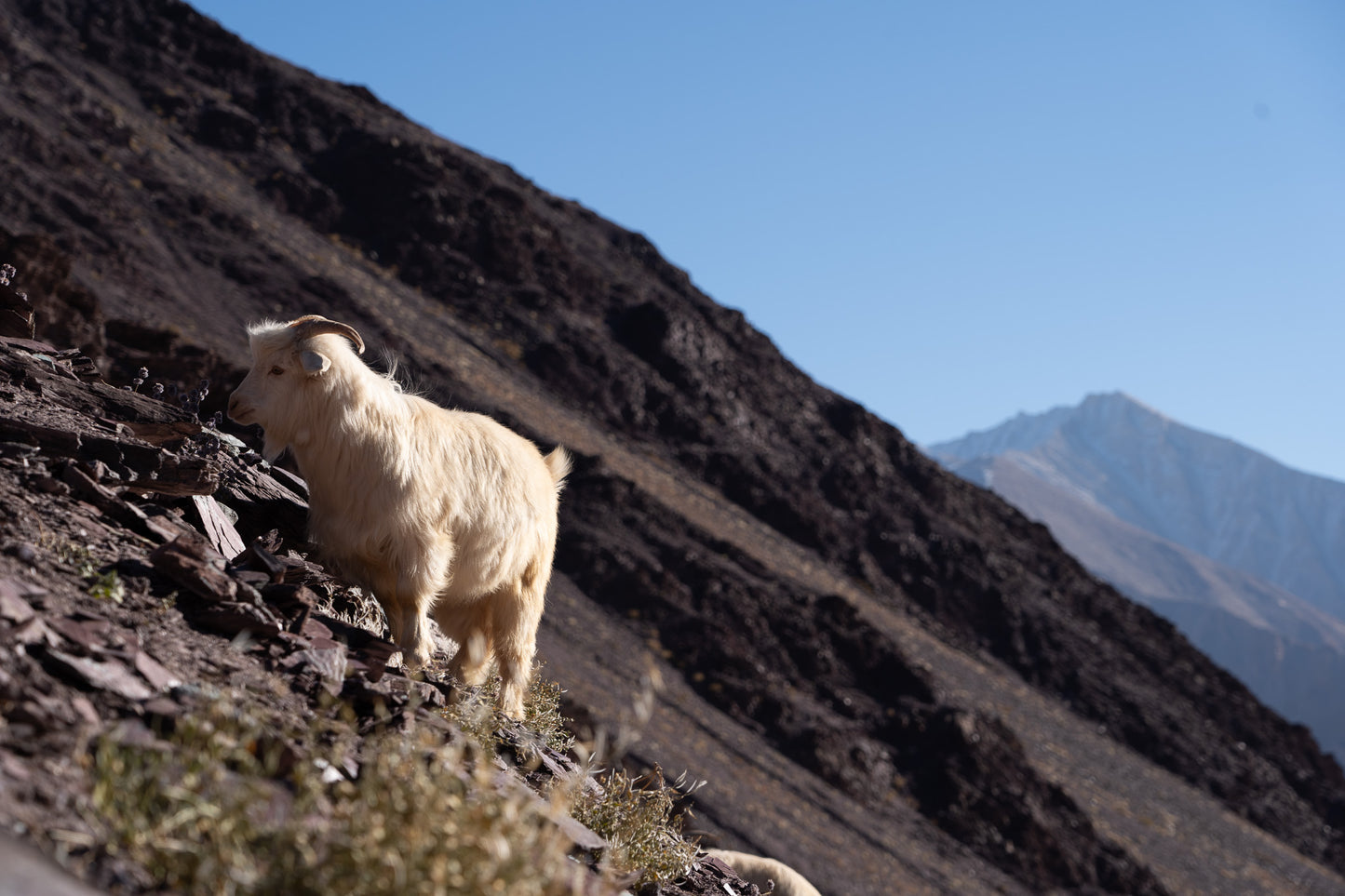
Pashmina, on the other hand, traditionally comes from the high regions of the Himalayas, particularly Ladakh. There, the Changthangi goats live under extreme climatic conditions with strong temperature fluctuations. To protect themselves from the cold, they develop an exceptionally fine and dense undercoat – the basis of genuine Pashmina.
Changthangi goats are kept in small herds by Changpa nomads, whose way of life is closely linked to the natural cycles of the region. The harvesting of their fine wool is carried out carefully and forms a central livelihood for many of these communities.


The crucial difference lies in the quality of the fiber . Pashmina is among the finest forms of cashmere. The fibers are exceptionally soft, long, and light – and remarkably warm. Genuine pashmina is made exclusively from the particularly soft undercoat of the Changthangi goat's chin and belly. These fine fibers are carefully combed only once a year , during the natural spring molt. The extreme temperature variations of the high-altitude regions result in a fiber of exceptional density, lightness, and warmth. This fineness makes pashmina not only rarer but also more demanding to process. While cashmere is available in many qualities, conventional cashmere production often harvests the wool from the entire animal multiple times as needed. This process blends fibers of varying thicknesses – from fine to coarse.
Genuine Pashmina, on the other hand, is produced only in limited quantities and retains its exceptional quality through origin, selection, and meticulous craftsmanship.


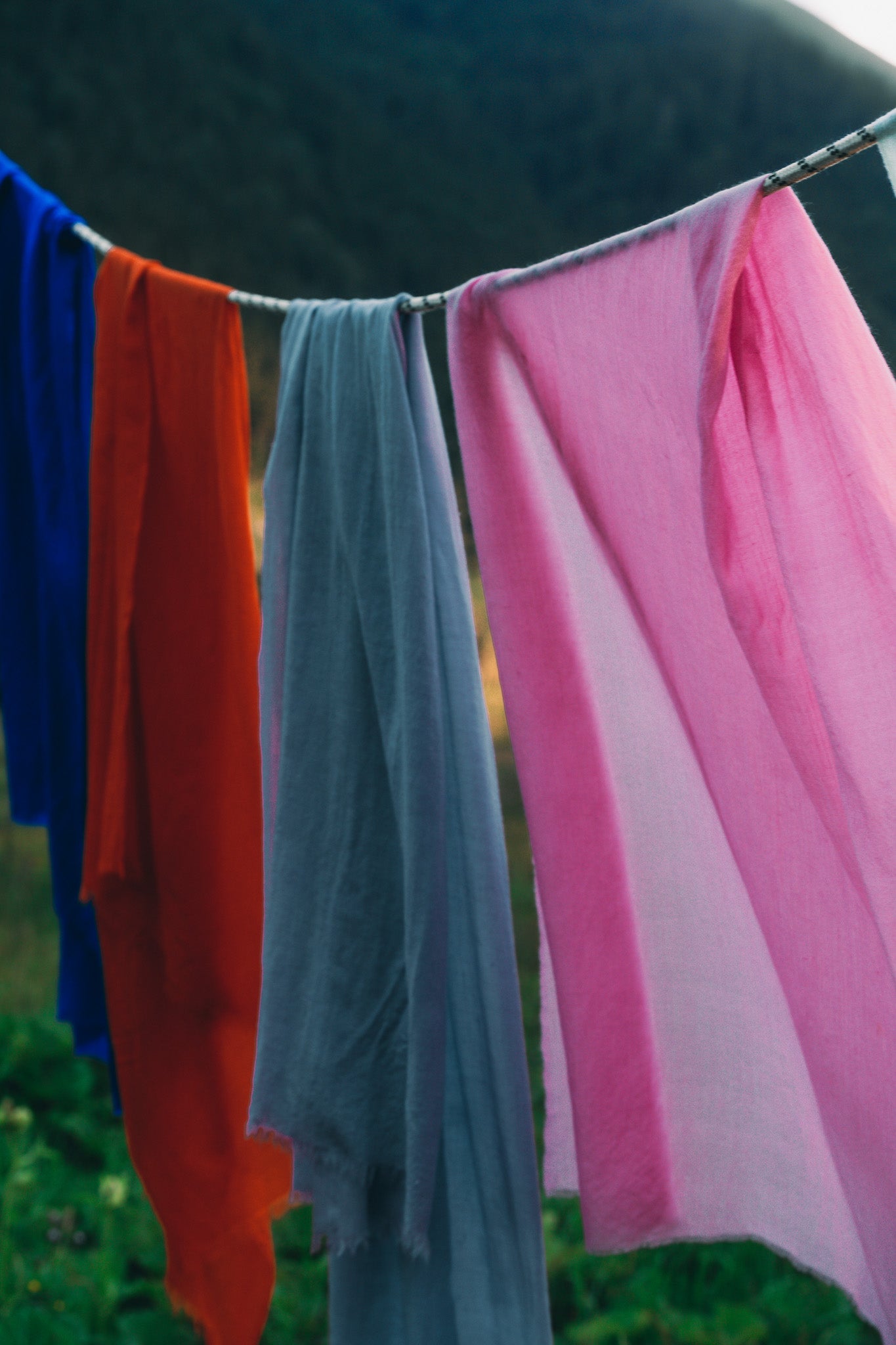
Cashmere can be processed by machine, depending on its quality. Pashmina, on the other hand, largely defies industrial processes. The fibers are so fine that they are traditionally spun and woven by hand. This artisanal process requires experience, patience, and precision. Each handwoven pashmina therefore bears its own unique signature. Minor irregularities in the weave are not a defect, but rather an expression of genuine craftsmanship and authenticity.


In direct comparison, pashmina often appears lighter and airier than conventional cashmere. At the same time, it possesses excellent temperature-regulating properties. It drapes softly without feeling heavy and adapts to the wearer over time. With regular wear, a high-quality pashmina becomes softer, more supple, and develops a more fluid drape – a natural change that underscores its quality. Not every cashmere product is pashmina.
The term Pashmina does not describe a style, but rather a specific combination of origin, fineness, and traditional craftsmanship. Today, it is often used without taking these distinctions into account.
Genuine Pashmina remains a subtle quality – it impresses not through volume, but through substance.
At Mārīci, we choose Pashmina in its purest form. Our scarves are made from the finest cashmere wool from Ladakh and are crafted with respect for the material, craftsmanship, and origin.
We understand the difference between Pashmina and Cashmere not as a judgment, but as an invitation to choose more consciously – for quality, time and craftsmanship.